Volunteers wear Ebola protection suits to dispel rumours

Volunteers of the Burundi Red Cross are visiting villages and homes to explain how people can protect themselves from Ebola. There are no cases of the disease in Burundi as yet, but the Red Cross is preparing for infections.
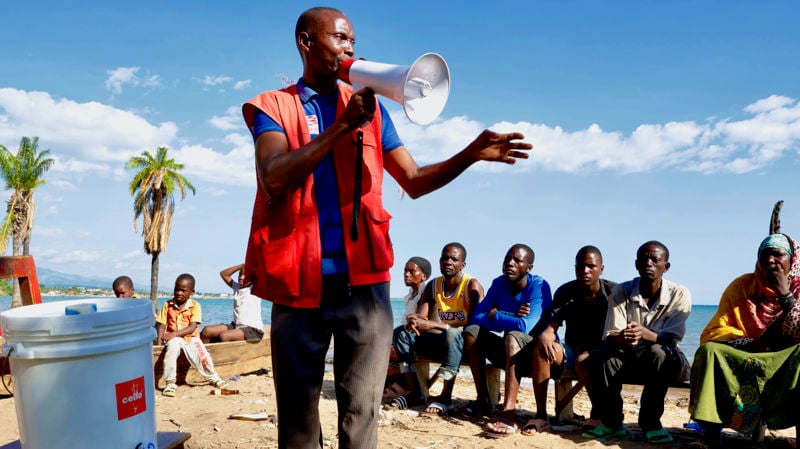
“We learnt about Ebola last year, but it’s useful to learn about it again!” Martin Asman Muntungeko, a volunteer with the Burundi Red Cross, is making an announcement over a megaphone.
The residents of the fishing village have gathered round the Burundi Red Cross volunteers to hear a briefing on Ebola. The waves of Lake Tanganyika lap against the sandy shore, on which people from the village in the Rumonge area have gathered.

On the other side of the lake lies the Democratic Republic of the Congo, where the 17th Ebola outbreak is under way. The epidemic has been caused by the Bundibugyo virus. There is currently no vaccine or specific treatment for this strain of the virus. There have been no cases in Burundi, but people are concerned because of the busy trade and cross-border traffic.
Muntungeko and Denis Niyungeko use pictures to explain the symptoms of Ebola and how to protect yourself from the disease.
“Many have heard of Ebola before, but there are always those who are hearing about it for the first time,” says Denis Niyungeko afterwards.
Seeing the protective suit helps to allay fears

Although it is hot and humid, the volunteers are helping Pascal Ndayizamba put on his Ebola protection suit. At the same time, Denis Niyungeko explains why healthcare professionals need to wear protective suits. Thanks to the protective suits, healthcare professionals are able to treat Ebola patients and those who have died from the disease.
“There are a great deal of rumours surrounding the protective suit, so it’s important that we explain why it’s needed. People trust us Red Cross volunteers, so when we show them the suit, it helps to allay their fears,” explains Pascal Ndayizamba, who has been a volunteer for 27 years.

To round off the briefing, Denis Niyungeko demonstrates how to wash your hands properly. He asks one of the villagers to demonstrate. Christine Bikolimana, 54, agrees to step before the villagers. The process is demonstrated according to the instructions.
Christine Bikolimana had heard about the disease on the radio before, but this was the first time she had received specific instructions on how to protect herself from it.
“I’m worried about Ebola; it’s a serious disease. It’s frightening that if someone falls ill with the disease, you can’t even touch them. I am grateful, however, that I now know how to protect myself from the disease,” says Christine Bikolimana.
Door-to-door information on Ebola

It’s a bustling day on the streets of Bujumbura, Burundi’s largest city. A dozen or so Red Cross volunteers are going door to door to raise awareness about Ebola.
“We always introduce ourselves and ask if we can talk about Ebola. No one ever turns us down. By going to every house in the area, we make sure that everyone is informed,” says Thérese Nizigiyimana.
“People are concerned about the situation. The symptoms and the speed at which the disease progresses are frightening. People listen to what we have to say with the utmost focus. It is important that they are also able to ask us about the disease,” adds Ernest Niyongabo.
As she keeps working, a woman weaving a basket asks what sort of meat is safe for her family to eat. Thérese Nizigiyimana replies that it is acceptable to eat one’s own livestock, but that it is not safe to consume the meat of animals that have already died. Another person asks whether Ebola has already reached Burundi. Ernest Niyongabo reassures us that this is not the case, but the border with the Democratic Republic of the Congo is close to Bujumbura, so the disease is not far away.
Revocat Niyongabo has been working as a volunteer for three years.
“Whenever I see someone who needs help, I’ve always wanted to help them. That’s why I became a volunteer. I intend to do everything I can to help to prevent the spread of Ebola in Burundi,” he says.
The Finnish Red Cross is supporting the Burundi Red Cross in its preparation and preparedness efforts planning for Ebola through its disaster relief fund, as well as with funding from the Ministry for Foreign Affairs and the European Union. There are 600,000 volunteers across Burundi, whom the Red Cross relies on to prepare for disease outbreaks. The aid will also strengthen the capacity of the Burundi Red Cross to respond should Ebola spread to the country.


Text: Minttu-Maaria Partanen
Communications Specialist