The use of artificial intelligence in the Red Cross’s communications and marketing

The Red Cross’s ability to operate depends on people trusting the organization. Maintaining trust is also the starting point for how we use artificial intelligence.
The Finnish Red Cross’s principle is that the use of artificial intelligence must never jeopardise our credibility. We do not use AI-generated content that gives a false impression of reality, nor do we replace material produced from real-life situations with AI-generated imagery.
Artificial intelligence can be utilised in the Red Cross’s communications and marketing in areas such as brainstorming and summarising text. However, we require that all material we publish is always checked by a human.
The Red Cross never uses AI-generated images or videos that may appear genuine in its communications.
AI-generated images designed to mimic documentary realism may mislead the public, undermine trust and portray the people depicted in an unfavourable light. For this reason, the Finnish Red Cross does not use AI-generated images depicting people who appear to be real. If the organisation uses artificial intelligence to produce material, this must be done in a way that respects the principles of the Red Cross and human dignity.
All material published in the name of the Red Cross must be consistent with our brand and visual identity. Using only the specified elements, ready-made material templates and photographs and illustrations creates the organisation’s recognisable and distinctive visual identity. Read more about our guidelines on visual communication.
We recognise that the use of artificial intelligence also requires a great deal of natural resources and therefore has significant environmental impacts. That is why we use artificial intelligence judiciously.
We comply with EU legislation on the labelling of content created or modified by means of artificial intelligence.
Guidelines for the use of artificial intelligence in the Red Cross’s communications and marketing materials
Here you will find guidelines on how to make use of artificial intelligence in the Red Cross’s communications products and marketing materials. The guidelines also include a summary of the EU’s rules on labelling AI-generated content. These guidelines apply to all Red Cross staff, volunteers and partners who produce materials for the Red Cross.
The Red Cross never uses AI-generated images that may appear genuine in its communications. Artificial intelligence must not be used to create images depicting the Red Cross’s aid work or any other Red Cross activities.
Images produced by the Finnish Red Cross are copyrighted and may not be used as source material for AI-generated content. The use of the Red Cross emblem, as well as other identifying features such as vests and collection boxes, in AI-generated images is also prohibited.
At the Red Cross, artificial intelligence may be used on non-representational images or images that do not feature people. For example, volunteers can use an image of a tree or tree leaves on an invitation to the branch’s autumn assembly.
In the case of AI-generated graphic material, it must be ensured that the material does not infringe copyright. If artificial intelligence is used to create graphic elements or images, it is essential to ensure that you have the right to use the source material utilised by the artificial intelligence.
Editing images with AI-assisted software is permitted, subject to the restrictions set out in these guidelines. AI-modified images must be clearly labelled in accordance with the guidelines issued by the EU. You can find a summary of the EU labelling rules in these guidelines.
The same rules apply to audio and video material as to visual communications: Artificial intelligence must not be used to create material that a person might mistakenly believe to be genuine. The use of editing software that utilises artificial intelligence is permitted in video material, provided that such use is properly indicated in the material.
In Red Cross materials, artificial intelligence may be used to support brainstorming and summarise text, for example. If artificial intelligence is used to summarise text or search for information, a human must always check the final text before publication.
Translations produced by artificial intelligence are checked before publication. If we use AI-generated translations on our website, we will state this at the bottom of the page.
EU legislation stipulates that content generated or substantially modified by artificial intelligence must be clearly labelled. On this page, you can read more about the obligations set by the EU and download the icons for labelling content.
EU labelling guidelines in brief
The labelling guidelines apply to AI-generated images, videos and audio, as well as automatically generated news or information texts. AI-generated characters must also be clearly labelled.
The labelling requirement applies to the following:
- Deepfakes, i.e. image, video or audio content that has been generated or manipulated by artificial intelligence to appear authentic and may depict real people, places, events or entities. We never use this type of material in the Red Cross’s communications or marketing.
- News, bulletins and other informative content aimed at the general public that has not been reviewed by a human must also be labelled. We at the Red Cross do not publish any content that has not been reviewed by a human.
The EU labelling requirement does not apply to the following:
- text content that has undergone human review and editorial processing
- text content for which a person or organisation assumes responsibility for publication.
- Red Cross content must always be checked by a human, and we always take responsibility for our publications. AI-generated images must always be labelled. You can find the guidelines for labelling modified images below.
The EU has published three main types of AI icons for labelling AI content:
- Basic AI icon: artificial intelligence has been involved in the creation of the content
- Fully AI-generated: the content has been created entirely by artificial intelligence
- Partially AI-modified: content created by humans has subsequently been modifiedwith artificial intelligence.
The use of these icons is not mandatory if it is otherwise made clear that the content has been generated or modified by artificial intelligence. The information must be clearly visible and easy to understand.
Editing images with artificial intelligence
Image editing that does not require a label:
- noise reduction
- minor cropping or straightening of the image
- colour, brightness and sharpness adjustments
- video stabilisation
- removal of red-eye or technical errors.
The obligation to label generally arises if artificial intelligence substantially alters the meaning or content of the material. Examples of such changes include the following:
- translations and summaries generated by artificial intelligence
- addition of new elements to an image or video
- removal of objects, people or backgrounds
- blurring of faces
- alteration of a person’s appearance
- significant colour and contrast adjustments
- colourisation of black-and-white material
- creation of composite images or videos
EU recommendations on the use of the label:
- appears immediately alongside the content
- is easily visible and is not obscured by other elements
- is retained even when the content is reshared
- includes explanatory text where necessary (e.g. ‘AI-generated’ or ‘AI-modified’).
Checklist: Permitted and prohibited uses of artificial intelligence within the Red Cross
- An example of a permitted image

Examples:
- Editing images by using AI-powered software:
- We recommend that you primarily edit any images by adjusting the settings manually. Artificial intelligence may be used for image editing, provided that it does not present a false picture of reality. We do not recommend making significant edits to images by using AI-assisted features, in order to avoid misleading the viewer. Please note the EU guidelines on labelling images that have been AI-modified.
- Creating graphic elements or abstract or illustrative images:
- It is permitted to create abstract or illustrative images – e.g. an image of autumn leaves may be used in an invitation to an autumn assembly. Please label the image in accordance with EU regulations.
- Using artificial intelligence to generate ideas for texts:
- Artificial intelligence can be used to generate ideas. If the final content has been written by a human, there is no need to label it as having been produced by artificial intelligence.
- Summarising texts:
- Artificial intelligence can be used to summarise texts. A human must check the AI-generated summary.
- Translation of texts:
- Texts can be translated by using artificial intelligence. A note regarding the AI translation must be included at the end of the text. A human must check the AI-generated translation. The publisher is responsible for the content of the text and for indicating that the translation was AI-generated.
- An example of a prohibited image
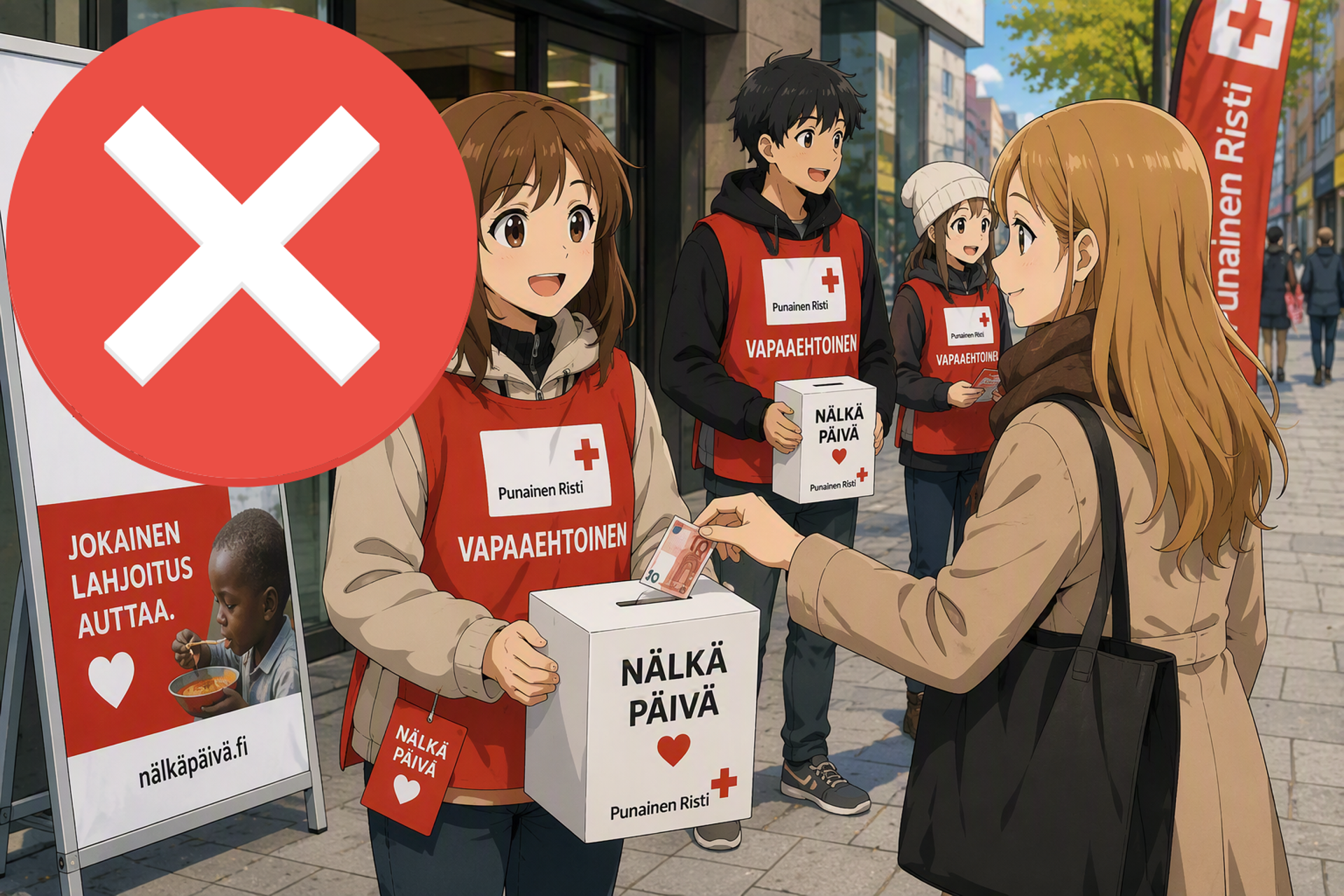
Examples:
- An AI-generated image depicting the work of a Red Cross branch:
- Artificial intelligence must not be used to create images depicting people, Red Cross aid operations or people receiving aid.
- Use of the Red Cross emblem:
- The protective emblem of the Red Cross, the Finnish Red Cross logo or any recognisable clothing, accessories or products associated with the organisation must not be used in AI-generated content.
- An AI-generated image depicting Red Cross food aid:
- Artificial intelligence must not be used to create images depicting the Red Cross’s activities, its operators or people receiving or in need of aid.
- AI-generated characters:
- Artificial intelligence must not be used to create human-like characters if they are portraying Red Cross operators or people receiving aid. In the case of animal characters or other mascots, the Red Cross brand guidelines must be followed. In such cases, please contact the Communications Services Unit, aineistot@redcross.fi
- AI modification of Red Cross images:
- Images produced by the Finnish Red Cross are copyrighted and may not be used as source material for AI-generated content.

Communications Services Unit
Do you have any questions about the use of artificial intelligence at the Red Cross? Please contact us at aineistot@redcross.fi.