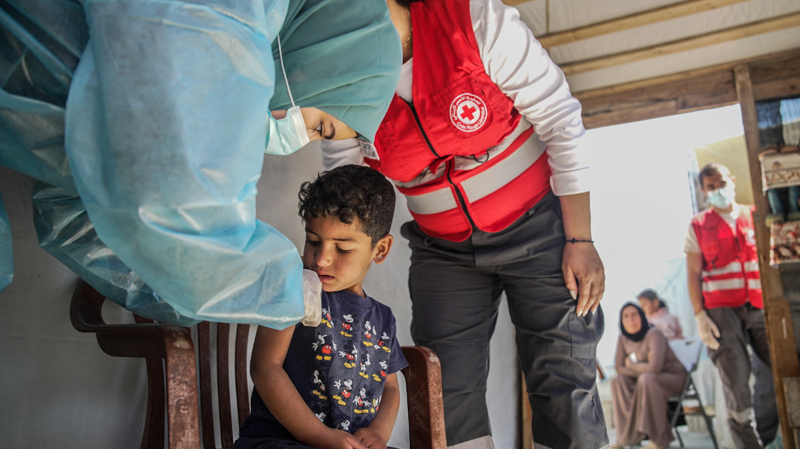
Refugee camps have become a way of life for over a million people in Cox’s Bazar in Bangladesh

The Finnish Red Cross has allocated 600,000 euros from its Disaster Relief Fund to the camps in Cox’s Bazar to improve people’s lives.
“When the violence broke out, my only thought was to get my family to safety. We left everything behind,” says Nur Haba at the Cox’s Bazar refugee camp in Bangladesh.
Nur Haba lost her husband during the unrest in Myanmar and was forced to flee to Bangladesh with her son and her elderly mother. The three of them have been living in the refugee camp at Cox’s Bazar for quite some time now.
Life as a single parent in the camp is not easy. The family’s first temporary accommodation did not offer them sufficient protection from heavy rain and wind.
“When the wind picked up during the night, I was awake. I held my son close to me because I was afraid our shelter wouldn’t withstand the storm.”
With the support of the International Federation of Red Cross and Red Crescent Societies (IFRC), the Bangladesh Red Crescent Society provided Nur Haba with a sturdier temporary home, built from bamboo, metal and tarpaulin.
“Now I can sleep without fear. When it rains, I’m no longer afraid that the shelter will collapse,” Nur Haba says.
Eight years on the run from unrest
The crisis in Rakhine in Myanmar has now lasted for eight years. It is one of the longest-running and most severely underfunded humanitarian emergencies in the world. In December 2025, nearly 1.18 million people who had fled Myanmar were living in 33 camps in Cox’s Bazar and Bhasan Char. These people are entirely dependent on humanitarian aid. The recent unrest in Myanmar has led to more people arriving at the camps.
In April, the Finnish Red Cross allocated 600,000 euros from its Disaster Relief Fund in response to an appeal by the International Federation of Red Cross and Red Crescent Societies (IFRC) to support the people living in Cox’s Bazar. The organisation aims to support the lives of nearly one million camp residents and 100,000 people living in neighbouring communities.
With this funding, the Bangladesh Red Crescent Society, supported by the IFRC, will be able to improve accommodation, water and sanitation services, as well as healthcare in the camps. In addition to this, residents receive cash assistance to help them buy essential supplies and food in some of the camps.
Volunteer support helped get my life back on track

Eight years ago, Sayedul fled Myanmar with his wife, Setara, and their two sons, and made his way to Cox’s Bazar. There was no work and nothing to do at the camp.
“I sat in front of our tent and stared into space. I had no strength, no purpose,” Sayedul says.
Marijan, who works as a volunteer for the Bangladesh Red Crescent Society, began visiting the family. He spoke about disease prevention, good hygiene and family planning. Marijan, who continued to visit, convinced Sayedul and Setara that they could improve their family’s life in the camp.
Thanks to Marijan’s teachings, Sayedul has become a respected figure in the camp. Neighbours come to ask him about matters relating to health, hygiene and family planning.
“I’ll tell them, ‘Look at me. I used to be ill and without hope. But someone believed in me, and I decided to change.’ We didn’t just survive – we started living again,” Sayedul says.

Text: Minttu-Maaria Partanen
Communications Specialist
Humanitarian aid