Logistics in emergency aid operation in Sudan filled with surprises

Logistician Jussi Laaksonen plans transport routes and warehouse locations in Sudan to ensure that aid can get to its destination. Nearly 34 million people in Sudan need humanitarian aid.
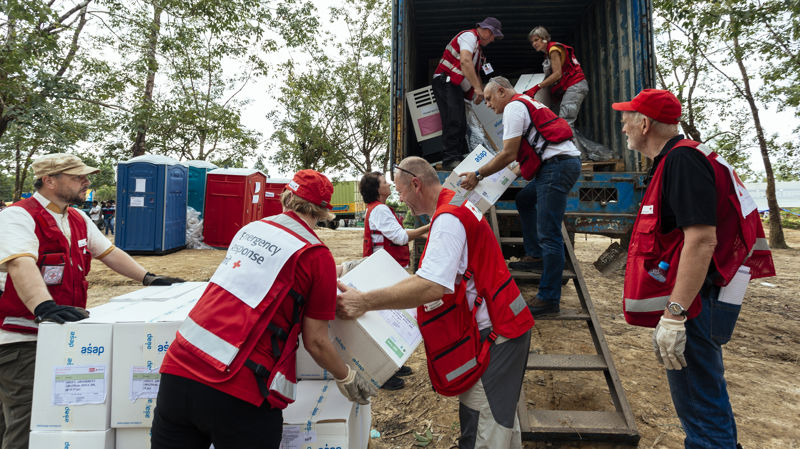
Logistician Jussi Laaksonen is walking in the brand new warehouse in port town Port Sudan in Sudan. A new Sudanese Red Crescent warehouse has just been completed in the city. It currently houses tents and food waiting to be distributed.
“The new warehouse quintupled the storage capacity. Currently, Port Sudan is the safest place to bring aid supplies to the country, because both the airport and the port are operational here,” Laaksonen says.
At the same time, the old warehouse was converted to a medical storage. Medicine and medical supplies are in great demand in Sudan.
“We built temperature control in the warehouse, which is critical in terms of medicine in this heat.”
At the moment, Laaksonen is also trying to find out how ambulances, which are direly needed in Sudan, could be imported to the country.
Sudan faces extremely serious humanitarian crisis

For the third year now, Sudan is suffering from an extremely serious humanitarian crisis. At the start of the year, it was estimated that nearly 34 million people needed humanitarian aid. This number has increased by more than three million from one year ago. The conflict has forced almost 10 million people to flee their homes.
In December 2025, the Finnish Red Cross awarded 700,000 euros from its disaster relief fund to the International Federation of Red Cross and Red Crescent Societies’ (IFRC) emergency aid operation in Sudan. As part of the aid effort, the Finnish Red Cross deployed logistician Jussi Laaksonen to Sudan to help with the logistics of the emergency aid operation.
According to Jussi Laaksonen, the country is in dire need of food and medicine. Camps for internally displaced people need basic supplies, such as water, shelter and hygiene supplies. Laaksonen is currently preparing a food aid shipment to the urban areas of Dilling and Kadugli together with the IFRC and the Sudanese Red Crescent.
“These areas are located in the conflict area, and we have had difficulty reaching them for a long time. The route has now been opened, and we want to make use of this opportunity as quickly as possible.”
Things change quickly in emergency aid operations
According to Jussi Laaksonen, his task is to make himself redundant. He is training employees of the Sudanese Red Crescent in logistics and in purchasing supplies according to good purchasing practices.
“I bring with me my knowhow of international logistics and trade. The locals, on the other hand, know how the local communities do business. I am doing my best to adapt my expertise to the local context.”
Sudan is a challenging area in terms of logistics. One aid route currently runs through Port Sudan. Another runs through neighbouring country Chad, where Laaksonen has planned transport routes.
The conflict has had a devastating effect on Sudanese infrastructure, such as bridges, roads, electrical and data networks as well as hospitals and warehouses. Aid routes must be planned carefully due to the challenging security situation.
“We have trouble reaching our colleagues in the field. We can send messages, but we are not always able to speak to them,” Laaksonen says.
New meaning to work

In 2014, Jussi Laaksonen started volunteering for the Turku branch of the Finnish Red Cross. A couple of years later he realised that he could use his logistics expertise in aid work, as well, and applied to the aid worker reserve. When Laaksonen sold his own logistics company, he started working on Red Cross commissions full time.
“I have always liked helping. When I was deployed to Ukraine on my first assignments, I thought that it was great that I had the opportunity to do something like this in my life.”
Having the support of friends and family makes going on assignments easier.
“My siblings and parents really support me, which makes it possible for me to leave.”
Sudan is Laaksonen’s seventh deployment. Experience helps him assess which solutions work and which do not. You need to be prepared for constant change at work.
“I may not be able to cross the border at the same place today as I did yesterday. The circumstances change all the time, but I can cope with it. I have the personality for it. I get along with people and I have learnt to deal with uncertainty.”
The best thing about his work is when the team succeeds in making a difficult delivery.
“Challenging deliveries force us to envision different scenarios and prepare for action in those situations. When we are able to make a delivery and bring aid to those who need it, those are the best moments of my work.”
The Red Cross helps in the conflict in Sudan
- by providing food, shelter, protection and clean water to internally displaced people
- by administering first aid and basic health care services as well as referring people to nearest clinics or the hospital
- by distributing cash grants to vulnerable people to allow them to buy necessities, such as food
- by preventing communicable diseases, such as cholera, from spreading; training volunteers and supporting the construction of water points and improvement of sanitation by e.g. providing toilets and places to wash.

Text: Minttu-Maaria Partanen
Communications Specialist
How to become an aid worker abroad