Study: Challenges faced by those relying on food aid are not limited to livelihood

A recent study paints an image of problems piled around poverty: loneliness and a sense of not belonging visible in the answers of those seeking food aid.
Financial difficulties faced by food aid customers have increased. However, the challenges faced by customers are not limited to livelihood. In addition to financial challenges, they feel burdened by disengagement, a low social standing and loneliness.
Those who rely on food aid rate their own position on the social ladder as lower than the rest of the population. According to the results of the food aid study, to be published in early 2027, experiences of not belonging and a low social standing were common among the recipients.
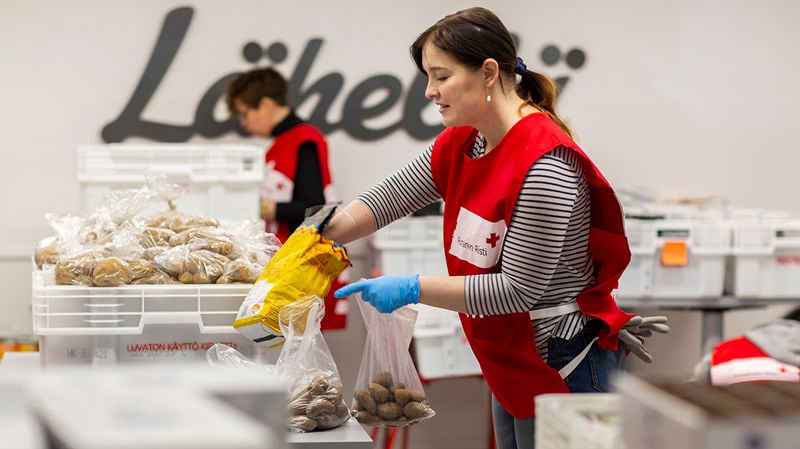
The food aid study was carried out in cooperation between the Finnish Red Cross and Tampere University and it examined the participation, quality of life and everyday coping of those who rely on food aid.
Over 1,200 food aid customers participated in the food aid study. The data collection was mainly coordinated by the Finnish Red Cross’s food aid coordination project (STEA), and Tampere University was responsible for the study.
Loneliness and feelings of not belonging common among food aid customers
Financial difficulties are known to be the most significant factor leading to the need of food aid. Many respondents feel that food aid plays such a vital role in helping them cope with everyday life that they would not be able to manage without it. For others, it simplifies everyday life in a significant way.
The study examined the wellbeing and coping of food aid customers and noted that poverty affects everyday life in many ways besides simply through the material shortage following the lack of money.
The study shows that different burdening experiences, such as loneliness and a sense of not belonging, are common among food aid customers. These experiences are particularly pronounced amongst people of working age who are outside the labour market due to unemployment or inability to work, as well as amongst respondents who do not share their daily lives with another adult.
‘Poverty isn’t just reflected in your bank balance. It manifests itself as loneliness and a sense of not belonging. People queue for food in food aid, but the study shows the simultaneous hunger for participation. People should feel like complete members of society,’ says Niklas Vaalgamaa, who is responsible for the Finnish Red Cross food aid coordination project.
The food aid study shows that a feeling of participation is an essential factor in wellbeing. A weaker sense of participation, on the other hand, appears to be linked to lower levels of trust in the authorities.
‘The importance of food aid in everyday life is linked to more than simply insufficient income. The study highlights the sense of participation as a key factor related to wellbeing. Wellbeing can be improved through increasing participation, as well as through reducng poverty. It is also important to consider how we could create communities that prevent loneliness and the feeling of not belonging, while enabling participation.However, this requires a shared will in society,’ says Tiina Vaani, a researcher working in the Vaurauden varjossa research project at Tampere University.
Part of a wider research project
The food aid study is part of a broader research project led by Juho Saari and entitled Vaurauden varjossa – huono-osaisten sosiaalinen asema 2020-luvun Suomessa, which studies the social status of disadvantaged people in Finland in the 2020s. In addition to food aid, data for the Vaurauden varjossa research project has been collected from the activities of diaconal work and the Deaconess Foundation, as well as from debt-ridden people, in low-threshold meeting places and in targeted communal meals in Kotka and Pori. In addition to this, Yle has conducted a survey to collect data on how people are coping in their everyday lives (in Finnish).
The overall results of the Vaurauden varjossa research project will be published as an e-book in early 2027.
The food aid study data was collected on 1 October 2025–31 January 2026 at food aid events organised by the Finnish Red Cross and other participating organisations throughout Finland by means of paper and electronic questionnaires. In addition to the Finnish Red Cross, data was collected by the Finnish Homeland Aid Work Alliance, the Finnish Blue Ribbon, Stadin safka, the Finnish National Organisation of the Unemployed, ViaDia, and Vantaa’s Yhteinen pöytä at their own events. The Finnish Red Cross collected data in the districts of Helsinki and Uusimaa, Häme, Southeast Finland, Oulu, Southwest Finland and Åboland.
Additional data was also collected, coordinated by Tampere University, from the Food banks of the Tampere Evangelical Lutheran Parishes and Seinäjoki Evangelical Lutheran Parish, food distribution events of Lakeuden ruoka-apu ry, Vantaa Shared Table events, and food aid events of Jyväskylän katulähetys on 11 May–31 July 2026.
For further information, please contact:
Niklas Vaalgamaa, Coordinator, Finnish Red Cross Food Aid Coordination Project (STEA), niklas.vaalgamaa@punainenristi.fi
Tiina Vaani, Researcher, Vaurauden varjossa research project, Tampere University, tiina.vaani@tuni.fi