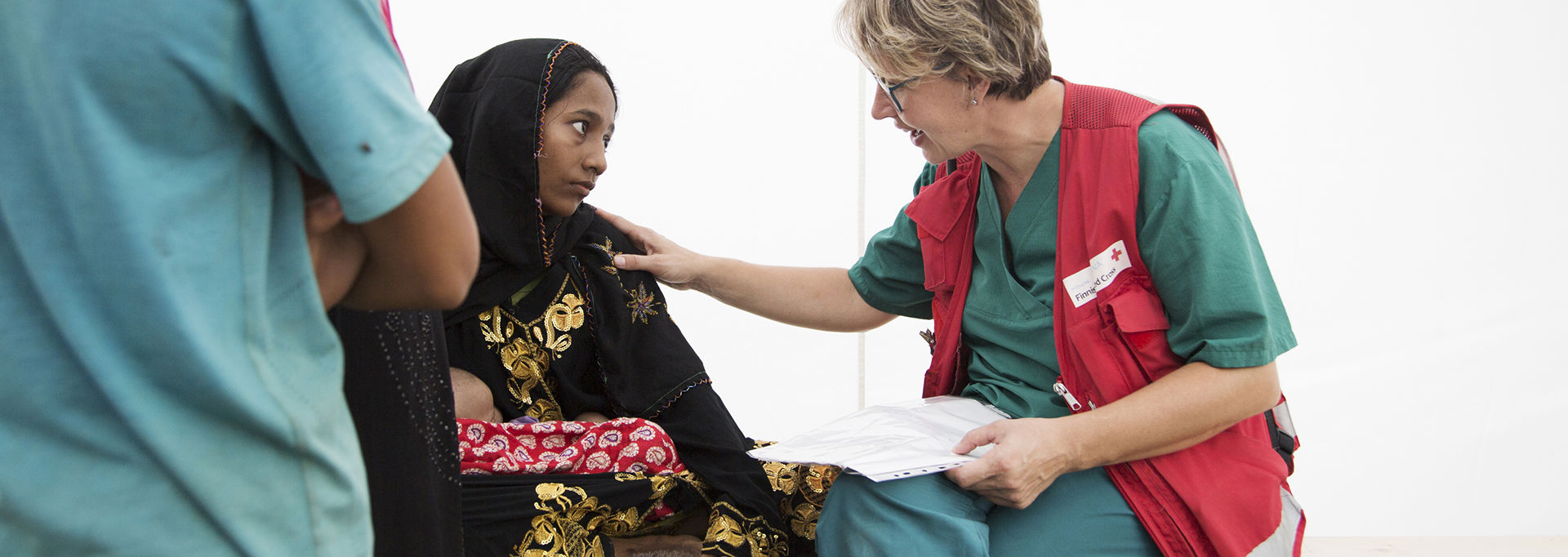
Become a humanitarian aid worker abroad
The Finnish Red Cross participates in the international disaster relief and development aid of the Red Cross and Red Crescent Movement around the world through various projects and operations.
Humanitarian aid workers form part of the Red Cross and Red Crescent chain of aid and work in cooperation with the local, regional and international aid community.
The expert assistance provided by the Finnish Red Cross is always based on locally identified humanitarian needs.
Humanitarian aid workers bring strong expertise in their respective fields to international aid work and are committed to operating in accordance with the principles and guidelines of the Red Cross and Red Crescent.
The Finnish Red Cross maintains a humanitarian aid worker reserve that supports both its own and the Movement’s ability to respond quickly and efficiently to humanitarian needs. It 2025 the humanitarian aid worker reserve includes approximately 1000 active members.
The humanitarian aid workers can be deployed world-wide where necessary. The humanitarian aid worker reserve is also an important instrument in supporting domestic preparedness and assisting in large-scale emergencies in Finland.
International assignments
The reserve is mainly used for emergency operations. The Finnish Red Cross recruits professionals for development aid assignments through an open recruitment process, also from outside the aid worker reserve. You can find open positions on the Finnish Red Cross as an employer website.
The Finnish Red Cross looks for professionals for the reserve who are ready and available to undertake short-term assignments in humanitarian aid operations. The Finnish Red Cross sends expert assistance to international operations and maintains a network of professionals trained to work in Emergency Response Units.
Humanitarian aid workers are also placed in long-term positions. Experts in various fields sent by the Finnish Red Cross support the sister Red Cross or Red Crescent National Societies in the planning and implementation of development cooperation.
Furthermore, the Finnish Red Cross strengthens the operational capacity of the Movement by funding strategically important positions of the committee and the federation.
Humanitarian aid workers are also recruited from outside the aid worker reserve on a job-by-job basis. You can find the open positions on the Työpaikkana Punainen Risti (careers) website.
Applying for the Finnish Red Cross humanitarian aid worker reserve
Application period is open once a year. The recruitment needs for the aid worker reserve are assessed on a year-by-year basis annually, and not all professional groups are opened for applications every year.
The applicants selected will be invited to take part in IMPACT training (International Mobilization and Preparation for ACTion), which is an introduction to the international activities of the Movement. After completing the training, the participants will be admitted to the humanitarian aid worker reserve.
To apply for the reserve, one bust be living in Finland or have a strong connection to Finland (e.g. Finnish citizenship or permanent residence in Finland) can apply for the reserve. The applicants selected must have the education, skills and language skills required for the international tasks of the Red Cross and Red Crescent.
Learn more about the work of international humanitarian aid workers and their requirements, as well as the general minimum requirements for admission to the reserve.
General requirements
Minimum criteria for applicants for the humanitarian aid worker reserve:
- Commitment to the values and principles of the Red Cross and Red Crescent Movement.
- Strong professional expertise in one’s field, described in more detail by areas of competence below.
- Degree requirements are defined by areas of competence.
- Fluency in spoken and written English. Skills in other languages used in international aid work (French, Arabic, Spanish, Portuguese, etc.) are assets.
- A category B driving licence and ability to drive (manual transmission).
- Good basic IT skills, fluent command of at least Microsoft Office 365 basic software in the Windows environment.
- Ability to cope with uncertainty, modest living conditions, hurry and pressure and adapt to changing circumstances.
- Ability to understand different cultures and ways of doing things.
Relevant international experience, facilitation and training skills and experience in non-profit organisations, particularly knowledge of the Red Cross and Red Crescent, are considered to be assets.
The reserve application process is organized once a year. The next application period will be open in December 2026.
Health care professionals work in the Emergency Response Units of the Finnish Red Cross, which the FRC deploys to support international operations. Health care professionals also work for long-term development cooperation projects.
Finnish Red Cross health units sent to disaster areas need staff with versatile experience in primary and acute health care in a hospital setting, first aid and treating patients of different ages. Health care staff are also required to have expertise in health education planning and implementation, and thus we are also looking for professionals with knowledge and experience in Public Health and Global Health to join the aid worker reserve.
Finnish Red Cross field hospitals need staff with strong and versatile experience in special health care in their field (e.g. surgery, deliveries, childhood diseases) who are able to work in tasks outside their own area of expertise in different wards. In the field hospital, work is focused on applying clinical skills, work organisation and training local colleagues.
The International Committee of the Red Cross deploys aid workers to conflict areas. Teams working in conflict areas, such as surgical teams, require skilled experts that can apply their skill sets to changing circumstances.
Comprehensive clinical skills are essential in patient work, because work is often carried out in changing roles and circumstances lacking in the tools and staff that are characteristic of Finnish health care. Health care professionals work with different patient groups in tasks that might be new to them. The Finnish Red Cross trains health care professionals in the aid worker reserve to be able to conduct their profession in disaster and conflict environments.
All health care professionals must have comprehensive work experience, fluent language skills, excellent teamwork skills and the ability to make decisions independently. Health care professionals also need to be ready to work in a multicultural work environment, with the help of an interpreter, if necessary. Important qualities also include training, leadership, coordination and coaching skills, as well as a participatory approach to work.
Promoting gender equality, diversity and non-discrimination, taking persons with disability into account and involving them, as well as comprehensively understanding vulnerabilities and taking them into account, are key themes in all operations. Knowledge of these themes is beneficial to all professionals.
Depending on the profession, the requirement is a degree from a university, university of applied sciences, or another professional degree (e.g. instrument technicians), and a minimum of three years of post-graduate work experience suitable for international Red Cross and Red Crescent humanitarian work. Alternatively, eligibility can be demonstrated by possessing solid professional expertise in the field developed through several years of work experience suitable for international Red Cross and Red Crescent humanitarian work. Doctors are required to have three years of work experience in the specified specialization field stated in the application.
Red Cross disaster health units need
- physicians (especially professionals in general medicine who work in health care centers/occupational health care, surgeons, gynaecologists/obstetricians, as well as anaesthetists, infectious-disease specialists, emergency physicians and paediatricians)
- nurses (especially operating theatre and anaesthetic nurses, as well as paediatric nurses)
- instrument technicians
- midwives
- medical laboratory technicians
- radiographers
- pharmacists / medical logisticians
- physiotherapists
- psychosocial support professionals
Other Red Cross health care missions need people from different educational backgrounds with
- experience in project management
- experience in operation management
- experience in planning and implementing health programs
- interest in supporting and developing health activities with the local Red Cross or Red Crescent
We are looking for disaster preparedness and response workers with language skills for comprehensive expert tasks. Disaster Management (DM) experts are needed in operative tasks of the International Federation of Red Cross and Red Crescent Societies (IFRC) and as support workers in operation coordination.
Disaster management experts are also needed to support Red Cross and Red Crescent preparedness programmes (so-called Disaster Preparedness / Disaster Risk Reduction, DP/DRR programmes) as part of Finnish Red Cross development cooperation. See section ‘development cooperation projects’
Aid workers working for preparedness programmes benefit from mastering at least one technical area, which may be connected to climate change, meteorology, risk mitigation, livelihoods, food security, cash distribution or water and sanitation.
The requirement is a degree from a university or university of applied sciences and a minimum of three years of post-graduate work experience suitable for international Red Cross and Red Crescent humanitarian work. Alternatively, eligibility can be demonstrated by possessing solid professional expertise in the field developed through several years of work experience suitable for international Red Cross and Red Crescent humanitarian work.
Cooperation skills and the ability to work as part of networks are key. We do not require aid workers to have experience of official duties, but experience from the field is seen as an asset.
Financial administration experts support short-term Red Cross and Red Crescent disaster relief operations, long-term development co-operation projects and the development of the financial management and economic sustainability of Finnish Red Cross partner national societies. Financial administration professionals must have a suitable degree (e.g. Master of Science in Economics and Business Administration or Bachelor of Business Administration) and a minimum of three years of post-graduate work experience suitable for international Red Cross and Red Crescent humanitarian work.
The key selection criteria for financial administration professionals are strong competencies in bookkeeping and cost accounting. Experience in budgeting and project management are considered to be assets as well as versatile language skills (especially French and Arabic).
In operations and projects, the environments and situations may be particularly challenging in terms of financial administration. Thus, financial administration professionals selected into the aid worker reserve must have good cooperation skills, patience and decisiveness. They must be able to manage the entire range of operations from individual receipts to investor reports.
Logistics professionals work in the Logistics Emergency Response Unit.
The Finnish Red Cross also deploys logistics experts to other international operations. Learn more about the tasks here.
Typical tasks for logisticians in disaster relief include setting up warehouses, arranging transport, managing importation of relief items and stock reporting. That is why we need logisticians with wide professional competencies.
Logisticians should master several sectors of logistics, such as inventory management, transport management, import/export or supply chain management. We require logistics professionals to have a relevant degree (e.g. a bachelor's degree from a university of applied sciences) and a minimum of three years of relevant post-graduate work experience. Alternatively, eligibility can be demonstrated by possessing a strong professional expertise in logistics developed through at least five years of work experience suitable for international Red Cross and Red Crescent humanitarian work.
Procurement professionals support both short-term and long-term disaster relief operations as part of the logistics team or in Emergency Response Units that the Finnish Red Cross deploys to support international operations. We require procurement professionals to have a relevant degree (e.g. Vocational Qualification in Business and Administration, Master of Science in Economics and Business Administration or Bachelor of Business Administration) and a minimum of three years of post-graduate work experience suitable for international Red Cross and Red Crescent humanitarian work.
The key selection criteria for procurement professionals include diverse work experience in various procurement activities and fluent proficiency in the English language. Field experience in international procurement is particularly beneficial for procurement roles. Experience in NGO procurement, procurement planning, budgeting, and logistics in general is considered an advantage, as well as versatile language skills (especially French and Arabic). Procurement professionals should also be prepared to work in a multicultural environment with the assistance of an interpreter, if necessary.
The operational environments and situations can pose particularly challenging issues for procurement. Therefore, procurement professionals selected for the aid worker reserve must be able to collaborate with financial management, colleagues, and local partners. It is crucial to have the ability to solve practical procurement issues while keeping the procurement guidelines clear in mind.
Cash and voucher assistance professionals work in short-term disaster relief operations (learn more about the tasks here) and long-term development cooperation projects in close collaboration with the local Red Cross or Red Crescent. Typical tasks include needs assessment, market assessment and cash assistance feasibility assessment, as well as planning, implementation, monitoring, and reporting of cash assistance distribution.
The requirement is solid professional expertise in cash and voucher assistance developed through several years of work experience suitable for international Red Cross and Red Crescent humanitarian work.
The Finnish Red Cross deploys Information Management experts to international operations (learn more about the tasks here) and long-term expert tasks. Furthermore, the Finnish Red Cross strengthens the operational capacity of the International Red Cross and Red Crescent Movement by funding strategically important positions of the committee (ICRC) and the federation (IFRC).
Information Management (IM) professionals are needed for for data and information collection, analysis, processing, storage, visualisation and reporting to support e.g. decision-making and coordination of operations.
Typical tasks include planning and supporting the implementation of beneficiary surveys or collecting data from various sources and refining it into infographics, narrative reports or maps.
IM experts need to have good cooperation and communications skills, a strong ability to analyse qualitative and quantitative data, strong IT skills, especially in spreadsheet computation software and geographic information software, as well as sufficient visual skills to produce infographics and other visualisations.
The requirement is a degree from a university and a minimum of three years of post-graduate work experience suitable for international Red Cross and Red Crescent humanitarian work. Alternatively, eligibility can be demonstrated by possessing solid professional expertise in the field developed through several years of work experience suitable for international Red Cross and Red Crescent humanitarian work.
We are looking for multitalented people with excellent technical skills and the ability to maintain and repair various devices, pitch tents, build furniture and fences from locally sourced materials, build electrical networks in the field using readymade cables and power rooms, as well as participate in the construction of water tanks and networks to support Finnish Red Cross Emergency Response Units, especially health care units.
The requirement is a degree from a university or university of applied sciences, or another professional degree and a minimum of three years of post-graduate work experience suitable for international Red Cross and Red Crescent humanitarian work. Alternatively, eligibility can be demonstrated by possessing solid professional expertise in the field developed through several years of work experience suitable for international Red Cross and Red Crescent humanitarian work.
Specialised professional competence is especially needed in electric installation and water treatment and distribution. Other technical skills may be acquired through hobbies in addition to studies and working life.
Technical staff need excellent teamwork skills and flexibility, independent initiative and the ability to apply their skills and the material at hand in challenging environments. Knowledge of hospital technology is considered an asset.
We are looking for IT professionals to support Red Cross Emergency Response Units. IT experts work in Information Technology and Telecommunications Emergency Response Units and support Health Emergency Response Units. In addition to IT skills, we also need radio amateurs with an understanding of how HF and VHF radio waves travel, and can install and repair mobile units and base stations and plan radio networks.
The Finnish Red Cross organises complementary training on the use of satellite phones and other devices, but IT aid workers are required to already have good knowledge of the Windows operating system and PC computer troubleshooting and repairs.
IT aid workers should also be able to build and configure computer networks. They must be skilled in communication control protocols and, preferably, also databases.
The requirement is a degree from a university or university of applied sciences, or another professional degree and a minimum of three years of post-graduate work experience suitable for international Red Cross and Red Crescent humanitarian work. Alternatively, eligibility can be demonstrated by possessing solid professional expertise in the field developed through several years of work experience suitable for international Red Cross and Red Crescent humanitarian work.
Knowledge of technology, in general, is considered an asset, because there is a limited number of missions available for IT aid workers.
The communications aid workers of the Finnish Red Cross produce written and audiovisual content primarily for the use of the Red Cross both in Finland and internationally.
We are looking for multitalented communication professionals with strong cooperation and negotiation skills. A flexible attitude is crucial, as work is often carried out in challenging and rapidly changing circumstances.
The requirement is a degree from a university or university of applied sciences and a minimum of three years of post-graduate work experience suitable for international Red Cross and Red Crescent humanitarian work. Alternatively, eligibility can be demonstrated by possessing solid professional expertise in the field developed through several years of work experience suitable for international Red Cross and Red Crescent humanitarian work.
An audiovisual expert must master both photography and video production (e.g. filming, editing, sound production and post-editing of images). Most tasks at the communications deployments include video production. We value the ability to experiment with and innovate new concepts (incl. on different social media platforms) and produce high-quality material even on a tight schedule.
Communication professionals must produce journalistic content at least in Finnish and English, plan and target communication as well as utilise social media. Experience of working in a newsroom and publishing across multiple channels are considered assets. We value the ability to plan and execute communication training as well as photography and manuscript writing skills.
A typical communications deployment lasts 2–3 weeks. On average, 1–3 deployments are open for recruitment annually.
We are looking for experts in public health, global health and disaster preparedness for long-term development cooperation work. They should have experience in community-level development cooperation projects and be familiar with global development issues at large. In long-term projects there is also a need for financial administration professionals. Development cooperation and financial administration professionals for long-term projects are also sought through open recruitment.
When selecting these professionals into the reserve, we highlight comprehensive competence in development cooperation project administration. Work tasks include, but are not limited to, the drafting of funding applications and project plans, preparing budgets, as well as monitoring, reporting and assessing the implementation of development cooperation programmes. Quality assurance of the programmes is a key component of the work. Familiarity with the main donors (e.g. Ministry for Foreign Affairs of Finland, EU) is a great asset.
The requirement is a degree from a university or university of applied sciences and a minimum of three years of post-graduate work experience suitable for Red Cross and Red Crescent development cooperation.
Development cooperation professionals always support the local Red Cross or Red Crescent, meaning that we value knowledge of the International Red Cross and Red Crescent Movement.
Gender equality, diversity, disability inclusion, a comprehensive understanding of vulnerabilities and mitigating the impact of climate change are key themes in all our projects. Professionals working in our development cooperation programmes benefit from knowledge of these themes.
Useful qualities also include education and training skills, as well as a participatory approach to work.
We are looking for university-educated people with versatile language skills who are suitable candidates for International Committee of the Red Cross (ICRC) tasks. Working for the Committee often requires committing to employment in a conflict area for at least one year. The tasks vary and may contain visits to prisoners of war and political prisoners, family reunification assignments, organising the delivery of emergency aid or serving as a humanitarian law expert. Learn more about the tasks and requirements here.
The Finnish Red Cross also deploys health care and logistics professionals in its reserve to work in ICRC operations in conflict areas.
The International Red Cross and Red Crescent Movement is committed to putting communities at the centre of our aid operations. Community Engagement and Accountability (CEA) is both our commitment and our process for working with communities based on their needs and feedback, supporting communities in highlighting issues that are important to them, providing information as a form of aid and supporting communications aiming for behavioural change.
An expert in community engagement and accountability promotes the involvement of various members and groups of communities in aid operations, both during disaster situations and when preparing for them.
Assets in CEA work include expertise and experience in social change, behavioural sciences, community communications, the collection and processing of qualitative information, and feedback systems. Expertise in gender equality and disability inclusion are considered assets.
The requirement is a degree from a university or university of applied sciences and a minimum of three years of post-graduate work experience suitable for international Red Cross and Red Crescent humanitarian work. Alternatively, eligibility can be demonstrated by possessing solid professional expertise in the field developed through several years of work experience suitable for international Red Cross and Red Crescent humanitarian work.
We are looking for experts with strong expertise in promoting gender equality and inclusion of disabled people (PGI, Protection, Gender, Inclusion) in development cooperation and/or humanitarian aid operations.
The requirement is a degree from a university or university of applied sciences and a minimum of three years of post-graduate work experience suitable for international Red Cross and Red Crescent humanitarian work. Alternatively, eligibility can be demonstrated by possessing solid professional expertise in the field developed through several years of work experience suitable for international Red Cross and Red Crescent humanitarian work.
We particularly value expertise in gender issues and the inclusion of people with disabilities as well as experience in activities to prevent sexual and gender-based violence and support the victims of such violence.
PGI experts are involved in the preparation of community and needs assessments and analyses, among other things. They ensure that funding applications, programmes and operations comply with both the policies and guidelines of the International Red Cross and Red Crescent Movement and the requirements of donors.
PGI experts support and monitor the implementation of programmes and operations and participate in their reporting and evaluation. Key tasks include the training of staff and volunteers and cooperation with other actors.
A PGI professional benefits from a comprehensive understanding and consideration of vulnerabilities, as well as knowledge of other cross-cutting themes (e.g. climate change, community engagement) and sectors (health, disaster preparedness / resilience).
PGI professionals always support the local Red Cross or Red Crescent, meaning that we value knowledge of the International Red Cross and Red Crescent Movement. PGI experts can act both in support of the Finnish Red Cross’s long-term programmes and in the Red Cross and Red Crescent Movement’s emergency response operations.
Useful qualities also include communication and presentation skills, as well as a participatory approach to work. Familiarity with the most important sponsors (e.g. Ministry for Foreign Affairs of Finland, EU/ECHO) is a great asset. Expertise in community engagement and accountability is considered an asset.
The field kitchen supports the operation of the Finnish Red Cross field hospital. The field kitchen chefs/cooks must be able to prepare nutrient-rich meals from locally available ingredients for the staff of the field hospital. They must also ensure that the kitchen is hygienic and the staff at the field hospital remain healthy. When necessary, the person in charge of the kitchen will also provide guidance in arranging food for the patients in the field hospital.
Kitchen devices, equipment and plenty of canned food and dried products will be sent from Finland with the field hospital. The person in charge of the kitchen must familiarise themselves with the local selection in foodstuffs and order the ingredients for the kitchen.
The person in charge of the field kitchen is aided by a sufficient number of local staff, meaning that the person in charge must be able to instruct the staff and work as part of the field hospital team.
The requirement is a professional qualification and a minimum of three years of post-graduate work experience suitable for international Red Cross and Red Crescent humanitarian work, or solid professional expertise in the field developed through several years of work experience suitable for international Red Cross and Red Crescent humanitarian work. Experience in restaurant management roles is beneficial in supervising the field kitchen.
Answers to questions frequently asked by the applicants
Finnish Red Cross aid workers working in international aid are not volunteers, but paid professionals working in demanding missions. The salary is determined based on the position and the individual, and in addition, a daily allowance or per diem is paid for work abroad.
The Finnish Red Cross contributes to disaster relief work abroad by sending professionals from different fields in aid work to support the local Red Cross or Red Crescent. Each year, our professional aid workers also serve in long-term development co-operation projects in support of our partner associations.
On the local level, the global humanitarian aid work organised by the Red Cross and the Red Crescent is based on volunteering. The Red Cross and Red Crescent have national societies in 191 countries, with millions of members and volunteers. You can also volunteer for the Red Cross in Finland.
In addition to strong professional competence, we value knowledge of the Finnish Red Cross and volunteering experience in our aid worker selections. That is why we recommend volunteering for the Finnish Red Cross for anyone interested in the IMPACT training.
Before starting a mission, all aid workers must undergo a medical examination paid for by the Finnish Red Cross. Aid workers are responsible for their own basic vaccinations, but the Finnish Red Cross will reimburse any other vaccinations required for the aid destination.
The Finnish Red Cross will arrange and pay for travel to the aid work destination and back home. The FRC will also cover accommodation costs for aid work. For other expenses incurred during work abroad (such as food and laundry costs), a daily allowance or per diem is paid. Aid workers are insured against accidents and illness.
The duration of missions in Red Cross and Red Crescent international aid work varies according to need. Most typical missions are disaster relief work missions of roughly 1–3 months or development co-operation missions of 1–2 years.
Aid workers must remain in the best possible health and shape during their international missions, in order for us to help those in need the best.
The circumstances on missions may be very taxing for example in terms of work load, rest and food. Disasters also increase the risk of infectious diseases. That is why each international aid worker must consider their own health and well-being carefully.
Work is often carried out in areas and countries with diseases spread through mosquitoes and diseases that can be prevented through vaccination. Aid workers must be ready to be vaccinated as part of their preparations for their international mission and, if necessary, take preventive medication for malaria during their mission. Vaccinations are an important part of occupational and patient safety for health care workers (including the time after they return home).
War and conflict areas typically have specific health-related requirements, because work is often carried out in places which are far away from suitable health care services and only reachable through difficult passages. Not all Finnish Red Cross aid workers end up working in war or conflict areas, however.
Aid workers must undergo a medical examination before each mission, in which the doctor assesses the person’s fitness for the work specifically in terms of their upcoming mission.
The Finnish Red Cross does not offer internships abroad. The available internships of the Finnish Red Cross in Finland are posted on our website.
The minimum requirements for the Red Cross aid worker reserve are 1) a professional degree (specified under each professional competence area) and at least three years of applicable work experience after graduation or 2) strong professional competence gained through several years of work experience suitable for international Red Cross and Red Crescent humanitarian work. See detailed position-specific requirements above. It is advisable to only apply for the aid worker reserve when the minimum requirements are met.
Qualifications and licenses of health care professionals, such as doctors and nurses, will be verified.
The Finnish Red Cross posts only professionals with extensive work experience in their chosen field to aid work abroad because the work is done in difficult contexts and often under different kinds pressure; we need to be sure that the aid worker can handle difficult situations and has enough professional certainty to adapt to change.
If you are interested in international Red Cross and Red Crescent operations, but you lack the necessary work experience, we recommend that you focus on developing other skills (e.g. language skills, knowledge of the Red Cross and Red Crescent, volunteering experience, relevant international experience, training and facilitating experience, negotiation skills) crucial for aid workers.
The work of practical nurses is truly important and valuable, but unfortunately, we cannot include practical nurses in our aid worker reserve because the qualification is not internationally standardized or recognized everywhere. For this reason, it is difficult to deploy this professional group as aid workers abroad.
Due to security reasons, having a driving licence and being able to drive are minimum requirements for the Finnish Red Cross aid worker reserve. It is very rare for an aid worker to have to drive a car during a deployment, but for example, in evacuation situations, they must be prepared to do so. Such a situation has not occurred at the Finnish Red Cross for years, but the safety of delegates is ensured in all circumstances by preparing for every realistically possible risk.
Basic IT skills are important in most international aid work assignments because all positions require at least some level of reporting and the use of IT systems or platforms. That is why the minimum requirement is mastering Microsoft Office 365 basic software in the Windows environment.
The IMPACT basic course for Red Cross and Red Crescent aid workers prepares participants for assignments in international aid work for the International Red Cross and Red Crescent Movement. During IMPACT, participants learn more about the structure of the Movement and familiarise themselves with the Movement’s disaster preparedness work and disaster relief. The course provides participants with basic knowledge about working in the context of the Red Cross and Red Crescent Movement, but does not offer profession specific training.
The course is multi-professional and contains important basic skills for experts in all fields from the point of view of international aid work for the Red Cross and Red Crescent Movement.
After completing the IMPACT course, participants become part of the Finnish Red Cross aid worker reserve. The IMPACT course does not guarantee being posted on a mission, but it opens many doors to international aid work missions and further aid worker training.
The need for international aid and the requests put to the International Red Cross and Red Crescent Movement determine when the Finnish Red Cross posts aid workers abroad. Aid worker vacancies are filled based on the skills required for the mission and the person’s suitability for the task, and they are also affected by aid worker availability.
IMPACT is the basic training course for Red Cross and Red Crescent aid workers after which participants become members of the Finnish Red Cross aid worker reserve.
Aid workers are selected for international missions from the FRC aid worker reserve, which is one of the largest in the International Red Cross and Red Crescent Movement and consists of professionals in many fields.
In addition to IMPACT training, the Finnish Red Cross offers many other trainings for members of its aid worker reserve. In addition to IMPACT, disaster relief missions generally require two other basic or specialised courses with a duration of a total of 3–8 days depending on the profession.
The International Red Cross and Red Crescent Movement is invested in developing the competence of its aid workers, which means that aid workers may progress and develop into a humanitarian aid project leaders through various learning opportunities in the course of their career.
Families may not accompany aid workers on disaster relief missions due to the generally deteriorated security situations.
Some long-term aid worker missions will allow families to accompany aid workers. Family deployments must be in a safe area and have a minimum duration of 12 months.
In the event of a disaster, a work assignment may come unexpectedly, and departure can happen with less than a day’s notice. For the first rotation, such as the team establishing a hospital, the notice period is usually about 2–3 days, whereas for later rotations it can be several weeks. For long-term aid worker deployments, there is more time before departure—usually at least 1–2 months.
The Finnish Red Cross encourages employers to enable their employees to participate in international aid missions, because we think that serving on an international aid mission supports an employee’s professional development and thus works to improve the disaster readiness and preparedness of the different sectors of Finnish society.
However, the Finnish Red Cross does not have this discussion on anyone’s behalf; each person must contact their employer themselves to confirm their availability.
Please make sure that you meet the minimum requirements. If you do not meet all of the requirements yet, develop your professional and other competence and apply only when you meet all of the minimum requirements.
Determine which international aid work task you might be suited for in terms of your professional competence and describe it in your application.
Present your professional and other competencies on the application, explain your motivation to apply for aid work with the Red Cross and your availability for international aid missions.
Describe the competence you have gained through or been able to utilise in your work and volunteer assignments. Your technical professional competence and manual skills should be clearly indicated. When applying for communications tasks, it is important that you attach some work samples to your application.
We receive many applications and unfortunately cannot admit all promising applicants. If you want to re-apply, first make sure that you meet the minimum requirements for aid workers. Also read about the professional competence areas of Finnish Red Cross aid workers.
Competence-specific needs within professional groups are also reviewed annually, so it’s worth applying again if you meet the minimum requirements. It may be that in previous years your expertise was not sought for one reason or another, but now there is a need for it.
Also consider whether you have described your own competence and motivation well enough on your application and improve your application before re-applying, if necessary.